The Lessons Beyond Faith
What struggle, migration and motherhood taught me about courage, karma, and finding a path beyond the storm ~ and beyond the faith I once knew
When I returned from India after leaving my young son at boarding school, I carried conflicting emotions home. There was relief that he was finally away from the bullying, but also the ache of leaving a child behind because I could see no other way to protect him.
Back home, the storm had not passed.
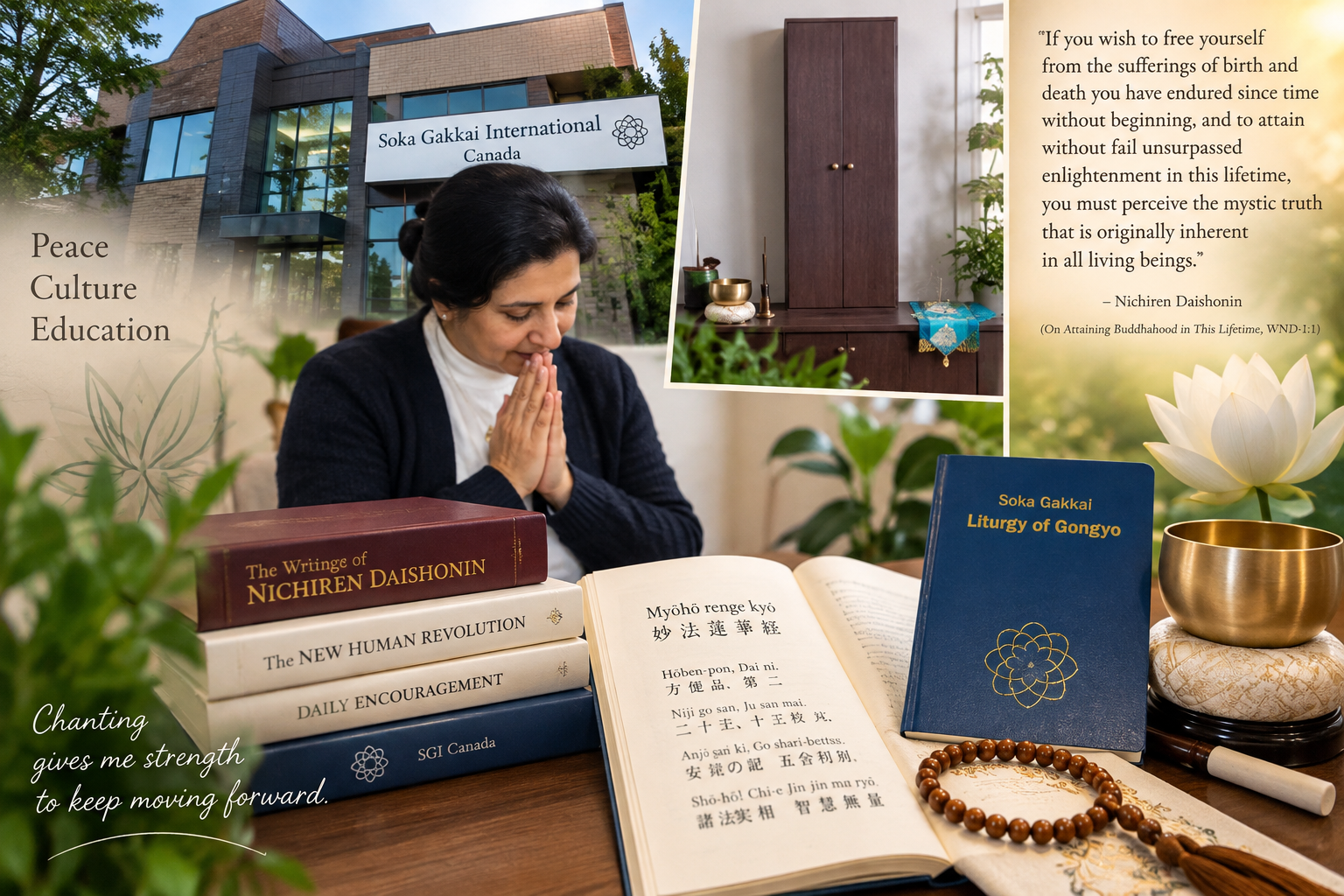
I continued my regular Buddhist practice, the chanting of Nam-Myoho-Renge-Kyo, Gongyo, the study of Nichiren Daishonin’s teachings, and participation in Zadankai meetings. These gatherings were held mostly at our district leader’s home, while other members graciously opened their doors from time to time.
My practice remained an anchor. When life made little sense, chanting gave me somewhere within myself to return.
Yet, increasingly, life itself seemed to be testing my faith.
My Daughter Was Trying to Find Her Place
My daughter, too, was searching for her footing in a new country.
We moved again, into another rental home. She became friendly with a neighbour’s daughter who lived in a blended family with her father, stepmother, step-sisters and biological brother.
Gradually, painful stories surfaced.
The two siblings spoke of feeling differently treated at home. Much of the cleaning and household work seemed to fall upon them. The brother, we were told, was sometimes expected to stay apart from his step-sisters - even sitting in another room.
The household brought together different countries, cultures and faiths - Muslim and Christian, with different Asian backgrounds.
But cultural or religious difference was not what troubled me.
Difference was never the problem. What mattered was how people treated one another across those differences.
Perhaps because I was already carrying my own children's pain, hearing another young person speak of exclusion struck a nerve.
Yet while I was noticing another family's struggles, something much closer to home was quietly brewing.
It concerned my daughter.
And I could not yet see it.
When Guidance Alters a Young Life
Another battle was unfolding within the education system.
My daughter was working toward admission to a full university degree program. Following academic guidance, she took higher-level Mathematics, English and Physics courses, believing they were necessary for the path ahead.
Only later did I understand the enormous influence a school counsellor can have over the direction of a young person's life, especially a newcomer who does not yet know how to navigate the system.
The guidance she received cost her almost two years, much of it spent repeating or completing studies that did not advance her as we had expected.
At the time, I lacked both the knowledge and confidence to question every recommendation.
I trusted the system.
Years later, while working with newcomers, that lesson stayed with me.
I would tell parents:
Ask questions.
Know what your child has already completed.
Seek a second opinion when something does not add up.
Challenge decisions respectfully when necessary.
Protect your child's ability, education and future.
Newcomer parents often hesitate. We assume that counsellors, teachers and professionals know the system better than we do.
Often, they do. But expertise does not remove a parent's right or responsibility to ask why. I learned that lesson the hard way.
When Experience No Longer Opens Doors
Their father was fighting a different battle, one familiar to countless immigrants. He arrived with more than three decades of architectural experience, including major turnkey projects, supported by approximately seven years of professional education in architecture from a highly respected institution.
Yet none of it seemed to open a door.
Employers would not offer him work even remotely related to the profession in which he had spent most of his adult life.
He kept trying. On professional advice, he enrolled in basic drafting courses, hoping additional local training might provide a foothold back into architecture.
Imagine spending decades mastering a profession, only to arrive somewhere new and be asked to prove, from the ground up, that you can do what you have already done successfully for most of your life.
Eventually, survival took precedence over profession. He accepted security work and whatever employment he could find. Behind it lay another kind of loss, not merely income, but professional identity, confidence and belonging. He was struggling to establish a family in a new country while quietly watching much of what had defined him professionally slip away.
I saw his struggle.
I was carrying my own.
Neither of us had found professional ground beneath our feet.
And our children were absorbing far more of that instability than I understood then.
Was This Karma?
My Buddhist practice continued to sustain me.
Chanting helped me gather the scattered pieces of myself. Zadankai meetings reminded me that hardship could be transformed and that suffering need not be meaningless.
Still, a question had begun to haunt me.
I had studied karma, the principle that causes from the past may appear as circumstances in the present, and that through sincere practice we can transform our lives.
But now I wondered:
Had I accumulated so much negative karma that it was surfacing through one hardship after another?
Was this why my son had suffered?
Why was my daughter struggling?
Why could their father, despite decades of professional achievement, not regain his footing?
Why did our family seem unable to reach calmer waters?
Faith strengthened me, but it did not silence the questions.
Perhaps genuine spiritual practice does not always give us immediate answers.
Sometimes it makes the questions deeper.
Holding On to the Teachings
I continued reading Sensei's guidance: Daily Encouragement, The New Human Revolution, New Century, SGI Canada publications and the Gosho. When the second volume of the Gosho became available, I bought it too.
We had also bought a new Butsudan in Canada to enshrine my Gohonzon.
One teaching stayed with me: transforming karma did not mean becoming someone else. It meant changing our inner state and discovering happiness from within the life we already had.
Many Gosho passages were heavily underlined.
One that remained especially close to me was “A Ship to Cross the Sea of Suffering.”
Its imagery stayed with me: “One who listens to even a sentence or phrase of the sutra and cherishes it deep in one’s heart may be likened to a ship that crosses the sea of the sufferings of birth and death. The Great Teacher Miao-lo stated, “Even a single phrase cherished deep in one’s heart will without fail help one reach the opposite shore. To ponder one phrase and practice it is to exercise navigation.” Only the ship of Myoho-renge-kyo enables one to cross the sea of the sufferings of birth and death.” ~ Nichiren Daishonin wrote to his disciple Shiiji Shiro.
I needed that ship.
Because, by then, the waters around me felt increasingly rough.
A Fear I Could Not Name
Something inside our home had also begun to change.
Their father had sunk deeper into depression. He spoke little, but anger lingered beneath the silence.
Slowly, I even became uncomfortable chanting in his presence.
There was a tension in the house; a fear I could feel but could not name.
It hung in the air like an approaching storm.
I could not pinpoint its source, yet something within me kept whispering that I needed to pay attention.
I shared our circumstances with SGI leaders and sought guidance. Members tried to encourage their father and even introduced him to professionals who might help him find direction.
I valued their guidance and implemented in daily life.
I prayed. I chanted.
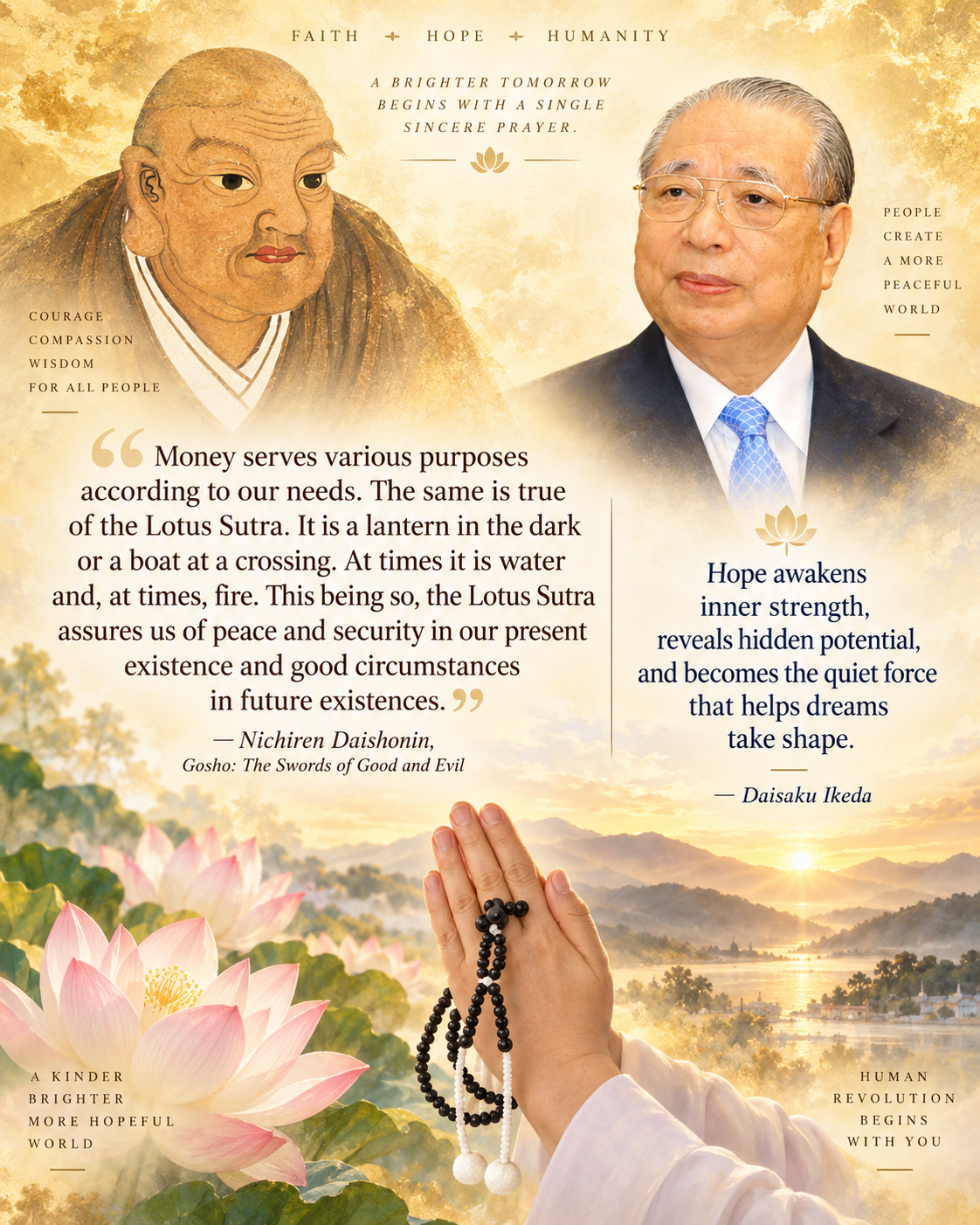
I hoped. Ikeda Sensei wrtote a lot about importance of ‘Hope’ and often I would remind myself of his messages and lectures. I would pick up a book or magazine to find an answer to my questions. Sensei’s quote: “The "remedy" for transforming pessimism into optimism is none other than hope. Hope is invincible. Hope changes everything. It changes winter into spring, darkness into dawn, descent into ascent, barrenness into creativity, agony into joy. Hope is the sun. It is light. It is passion. It is the fundamental force for life’s blossoming.”
Yet the situation continued to deteriorate.
What I Understand Now
Looking back, I no longer see those years only through the lens of karma.
Life was also schooling me.
I was learning to question.
To seek help.
To speak up.
To challenge institutions respectfully when they failed a child.
To recognize how easily educated, experienced newcomers can lose their bearings inside unfamiliar systems.
And perhaps most importantly, I was beginning to understand that spirituality should never become passivity.
Faith can steady us - but eventually, inner strength must become wise action.
Years later, when newcomers sat across from me bewildered by their children's schools, lost careers, unfamiliar institutions or the painful feeling that nobody was listening, I understood something of their fear.
I had lived my own version of it.
What had once appeared to be a string of unrelated hardships was slowly becoming an education of another kind.
The struggle was teaching me lessons I would later use to help others.
I simply could not see the pattern yet.
And beneath everything else, one unsettling question remained:
What was happening in my daughter's life that I still could not see?