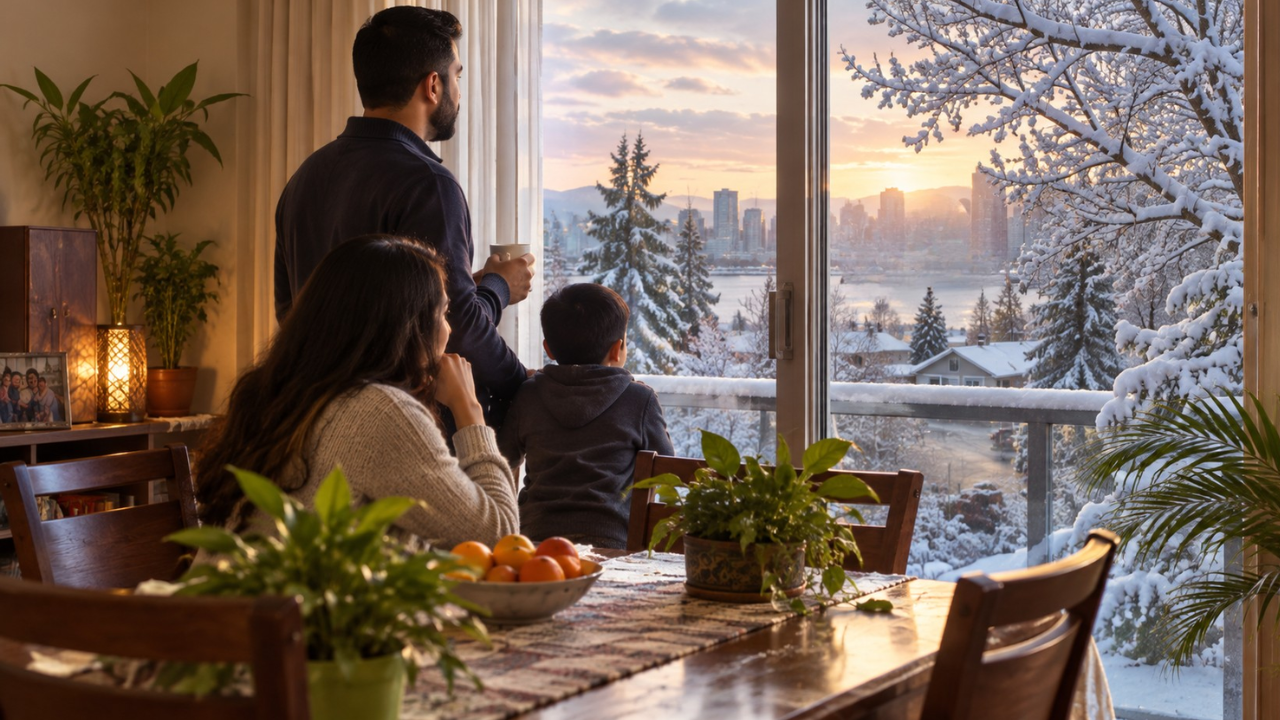
Daisaku Ikeda -The New Human Revolution
Your roots are not physical anchors tied to a single plot of geographic dirt. Your roots are a living current. They are the stories of your ancestors, the resilience of those who walked before you, and the warmth of the hospitality you carry in your chest. Physical soil can be left behind; the internal soil goes wherever you walk.
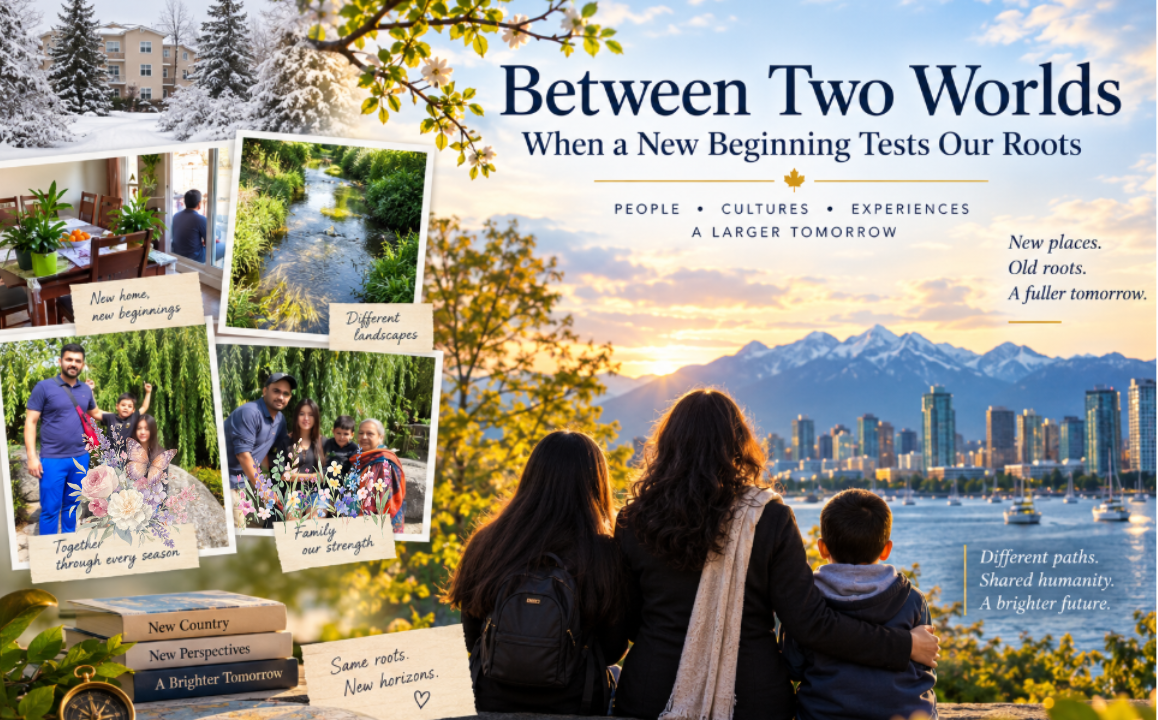
Roots…
A young seed may adapt quickly to
new soil, but a mature tree arrives
carrying years of roots: memories,
relationships, skills, values, confidence,
habits and cultural understanding.
Immigration and Roots
Immigration is often described as beginning a new life.
But perhaps it is more like transplanting a mature tree.
A young seed may adapt quickly to new soil, but a mature tree arrives carrying years of roots: memories, relationships, skills, values, confidence, habits and cultural understanding. When that tree is moved, it does not suddenly become rootless. Yet it must somehow learn to draw nourishment from unfamiliar soil while preserving everything that has shaped it.
That was how our early life in Canada began.
We had crossed geographical borders, but it soon became clear that crossing a border on a map was far easier than crossing the invisible borders between cultures, institutions, assumptions and perceptions. We arrived with hope. My children brought their education, abilities and personalities with them. We were ready to learn about a new society and become part of it. What we had not expected was how often we would first have to prove that we belonged.
When a Classroom Becomes the First Cultural Bridge
For immigrant children, a classroom is much more than a place of education. It can become their first bridge into a new society.
My son entered Grade 4 without a language barrier. He communicated comfortably, yet when he asked questions about unfamiliar classroom expectations and procedures, he often received little guidance from his teacher.
To an adult, a classroom rule may seem insignificant. To a child entering an entirely new educational culture, even small uncertainties can feel like standing at a crossroads without a signpost. A newcomer does not necessarily lack ability. Sometimes, they simply do not yet know the unwritten map.
Every culture has such maps, rules rarely explained because those who have lived within them for years no longer notice they exist.
This became one of my earliest lessons about cultural integration. We often expect newcomers to adapt immediately, forgetting that meaningful adaptation requires participation from both sides.
A bridge cannot be built from only one riverbank.
My daughter's experience was different and yet equally revealing.
She had already completed high school in our home country, but a career counsellor suggested that she repeat Grade 12 in Canada to ease her transition into university or college. She therefore re-entered Grade 12 as an academically capable student with strong English proficiency. Her English teacher quickly recognized her potential and recommended higher-level courses. Yet, in contrast, a school counsellor steered her toward basic language classes. The contradiction was difficult to understand.
One person saw her abilities.
Another appeared to see first the label new immigrant - interestingly, someone from our own cultural background. It seemed that newcomers were being placed into the same category rather than assessed individually. There was so much more to this, a deeper reality that I would confirm much later.
My daughter's potential had not changed when we boarded an airplane. Her intelligence had not disappeared at immigration control. Yet it became clear how quickly assumptions can place a ceiling over another person's possibilities.
This is where diversity asks something deeper of us. It is not enough for many cultures simply to exist beside one another.
True diversity begins when we become curious enough to see the individual behind the category.
A multicultural society can contain dozens of languages, foods, festivals and traditions, but genuine inclusion requires something more subtle: the willingness to meet another human being without deciding beforehand what they are capable of.
The Unexpected Complexity of Community
People from familiar cultural backgrounds initially seemed likely to offer a natural source of comfort. Sometimes they were. But migration taught me that shared culture does not automatically create shared consciousness.
One neighbour initially appeared extremely supportive and even helped me find employment. At a vulnerable stage of our transition, that kindness meant a great deal. But the situation changed dramatically when we discovered that he had begun stalking my daughter.
Someone who had appeared to be helping us had become someone from whom my family needed protection.
I left the job.
Financially, it was painful. As a mother, however, there was no real choice.
Safety came first.
That experience changed my understanding of community. We sometimes imagine culture as a protective blanket, yet culture is only one thread in the much larger fabric of human behaviour. People belonging to the same language, religion, nationality or background can carry completely different values and levels of consciousness. This was the worst discrimination that was unveiled.
Spiritual understanding gradually taught me not to confuse familiarity with goodness.
A familiar face is not automatically a safe face.
Nor an unfamiliar culture automatically threatening.
The deeper question is always: What consciousness is this person living from?
Fear or compassion? Control or respect?
Superiority or humility? Self-interest or genuine care?
When humanity is viewed at this level, many external labels begin to lose their importance.
When Your Professional Identity Becomes Invisible
Another challenge touched my professional identity.
Years of creative work in my home country had given me skills, experience and confidence in design. Yet when seeking career guidance from a newcomer-serving agency, I was bluntly told that my abilities would probably not be valued because of where I came from.
The dismissal was difficult to absorb.
We often hear that immigration requires people to rebuild their careers. Less frequently discussed is the emotional impact of being treated as though everything achieved before migration has suddenly become invisible.
Your passport has changed.
Your postal code has changed.
But your knowledge has not evaporated. Your creativity has not been erased. Your years of learning have not disappeared.
And yet many newcomers experience the unsettling feeling of standing before society holding an entire book of experience while being evaluated only by its cover.
This was especially painful because we had moved from a modern, fast-paced capital city, leaving behind a sophisticated creative and professional environment. Yet we were suddenly encountering assumptions that reduced an entire country and its people to stereotypes.
It also deepened my understanding of cultural diversity.
Every culture contains knowledge.
Every society develops strengths.
Every migration brings more than labor into a country. It brings memory, language, art, ideas, skills, traditions, resilience and different ways of seeing the world.
When someone's previous experience is dismissed simply because it was acquired elsewhere, we do not merely diminish the individual.
We diminish what diversity could have contributed to the whole.
During those years, our family itself was stretched between two countries. For part of his elementary and middle-school years, my son returned to our home country to attend boarding school. Their father also returned for a period, hoping to re-establish the business we had closed when we decided to settle in Canada.
Meanwhile, my daughter entered the workforce and secured a position with a bank. In time, I found work with a non-profit organization supporting newcomers.
That role broadened my understanding of settlement. The challenges were no longer visible only through the experiences of my own family. Day after day, the work brought me alongside people navigating unfamiliar institutions, cultural expectations, employment barriers and the emotional uncertainty of beginning again. Behind some doors were far more difficult realities: family conflict, domestic abuse and struggles rarely spoken about openly. My clients just would come and share their stories, searching for answers and solutions, and all that offered to them were my lessons through my spiritual study, experiences and knowledge. The feedback was full of gratitude and gifts which I gave to the nonprofit.
Those stories stayed with me. Years later, after COVID-19, they would become part of the deeper impulse behind Conversations 3X: creating space for conversations that had too often remained unheard.
Personal experience and professional observation inevitably began to intersect.
Living Between Cultures
Migration can bring a strange stage when you feel that you belong fully to neither world.
The country you left continues without you.
The country you entered has not yet fully opened its doors.
You stand somewhere in between.
But perhaps that space between cultures is not only a place of confusion. Perhaps it can also become a place of expansion. When two cultures meet, there can certainly be friction. Values differ. Communication styles differ. Expectations around family, education, work, privacy, authority and community can differ.
Throughout those years, Nichiren Daishonin’s Gosho and Ikeda Sensei’s guidance were not simply teachings I studied; they shaped how I tried to think, respond and live. It was nearly two decades of my Buddhist practice, and despite later choosing to move away from it, certain words remained deeply rooted and returned at critical moments: “Winter always turns to spring.”
Another message from Ikeda Sensei stayed with me: “While our language, culture, ethnic and religious heritages may differ, the future we must share, the future of the young people of each society, is one and the same.” I believed deeply in that vision. Yet the world around me often seemed to tell a different story. At times, the distance between the ideal and lived reality left me disheartened, even weakened.
But friction is not always destructive. Sometimes friction is what lights the match.
Living among diverse cultures can challenge the unconscious assumptions inherited from our own upbringing. It can lead us to ask:
Why do I believe this?
Is this a universal truth, or simply what I have always known? And where, within all this, is the human spirit?
Can another culture teach me something without threatening who I am?
Can I retain my roots while allowing new branches to grow?
At such moments, I would remember guidance from Ikeda Sensei in The New Human Revolution to a young man who had migrated to the United States and, perhaps, was facing his own struggle of cultural belonging. As I remember its essence, the message was that our roots are not confined to the place we came from; they can also take hold in the place where we choose to settle and build our lives. That thought stayed with me. Perhaps migration was not asking me to abandon my roots, but to allow them to deepen in new soil.
Ikeda Sensei notes in The New Human Revolution 1, that he was giving guidance to a student who moved from Africa to the United States and was afraid of fast moving America and he feared losing his identity: “… your roots are not physical anchors tied to a single plot of geographic dirt. Your roots are a living current. They are the stories of your ancestors, the resilience of those who walked before you, and the warmth of the hospitality you carry in your chest. Physical soil can be left behind; the internal soil goes wherever you walk. To thrive in this new land, you must not become a ghost of Africa, nor must you become a mirror of America. You must be the bridge. Take the discipline, the opportunity, and the structure of this new world.”
I think I survived the troughs and crests because somewhere Ikeda Sensei’s messages and Nichiren Daishonin’s Gosho, and spiritual guidance stayed deeply embedded in my heart. Over time, cultural diversity began to appear not as a demand to erase one's identity, but as an invitation to enlarge it.
Integration does not have to mean disappearing into another culture.
It can mean learning to stand confidently at the meeting point between worlds.
When the Outer Ground Shakes, We Search for Inner Ground
As our savings diminished, so did much of my early optimism.
Educational challenges, concerns for my children's well-being, professional setbacks and financial uncertainty accumulated. The dream of a fresh beginning was becoming something far more complicated. Yet difficult periods often reveal what comfortable times allow us to overlook.
When the external structures we rely upon begin to shift, we are compelled to discover whether there is something within us that can remain steady.
This was where the immigrant journey also became a spiritual one. Life sometimes removes our familiar signposts and turns and crossings seem to mislead.
The people we expected to support us may disappear or so it may seem. The qualifications we believed would protect us suddenly seem inadequate.
Financial security simply shrinks. The difference between reality and dream needs to be confirmed, where are we?
We were misgiuded by a family who were ‘helping families’ secure a financial future, and till date we are bearing the consequences. They were from our culture.
The identity that once gave us confidence may be questioned.
And we find ourselves standing in an unfamiliar landscape asking:
Who am I when the world no longer reflects the person I thought I was?
Perhaps this is one of life's hidden invitations. The outer journey takes us from one country to another. The inner journey takes us from dependence upon external recognition towards a deeper understanding of ourselves.
A storm teaches a tree something calm weather never can: how deeply its roots reach.
What I Would Tell a Newcomer Today
Looking back, I would not simply tell a newcomer to “be strong.” I have felt this wind, bring different type of storms. Name it I have endured and Reset my Core. Strength loses meaning during such moments. It certainly does not mean silently enduring everything. Strength may mean asking another question when the first person dismisses you. It may mean re- routing. It may also mean walking away from an unsafe situation even when doing so carries a financial cost. Or it may bring out that force that will enable the ‘refusal button’ in your action- and disallow someone’s controlled limited perception to become your definition of yourself.
One of the enduring lessons from those years was to retain faith in one's abilities, seek alternatives, reach out to institutions and community organizations, and communicate directly with educational authorities rather than surrendering to fear.
Today, I would add something more:
Do not allow an unfamiliar environment to make you unfamiliar to yourself.
Listen.
Learn.
Adapt.
Respect the culture around you. Remain curious about people whose experiences differ from yours. But carry your inner compass with you.
Because adapting to a new land should never require abandoning your dignity.
One Humanity, Many Cultural Lenses
With time, something beautiful began to emerge from the complexity.
We may stand at different vantage points beneath the same expansive sky. Culture, upbringing, history and personal experience shape both what we notice and how we interpret it. From one vantage point, family may dominate the horizon; from another, independence. One society may place greater value on the collective, while another emphasizes the individual.
Cultures are like prisms through which the light of humanity is expressed in different colours.
No single colour contains the entire spectrum, just as no single cultural perspective contains the entirety of human experience.
For almost decade, I observed how the language of diversity and inclusion was presented and practised around me. During that period, I invested nearly two years and considerable resources in formal education in intercultural communication, diversity and inclusion, hoping to understand these frameworks more deeply.
The education was valuable, and its insights became naturally woven into my daily life, presentations and workshops. Yet my personal experiences, together with years of working with newcomers, revealed a growing gap between the language of inclusion and the reality experienced beneath its surface. Some initiatives appeared inclusive at the surface while deeper layers of cultural division, categorization and separation remained largely untouched. By 2014, it had become difficult to ignore that simply naming, classifying and representing differences did not necessarily bring people closer together. At times, the very structures intended to overcome division seemed capable of reinforcing it.
A Venn diagram may neatly illustrate where cultures and identities intersect, but human understanding cannot be reduced to overlapping circles. It requires openness, self-reflection and the willingness to see beyond our own cultural lens.
Looking back, that realization remains deeply important.
Inclusion cannot remain a surface-level exercise; it must reach deeper into how we perceive, relate to and understand one another.
Manifesto 2000, the global UNESCO initiative promoting a culture of peace for the new millennium, often came back to me. Years earlier, I had passionately gone from school to school sharing its message. Yet as time passed, society often seemed to be moving further away from that ideal.
But when spiritual understanding enters the conversation, another dimension emerges.
Beneath nationality, language, ethnicity, occupation and social status is a human being, and beyond these changing identities, a conscious being moving through experiences, learning, evolving and searching for meaning. Throughout this period, regular prayers, Buddhist SGI study and Zadankai meetings, followed later by Sahaja Yoga meditation, helped keep me grounded and centred.
While the outer world continued drawing borders, the inner journey kept inviting me to cross them. Perhaps this was one of the greatest lessons hidden within those difficult early years: We had migrated to another country, but life was asking me to migrate into a larger understanding of humanity.
By then, we had purchased our first apartment. My daughter had married and bought a home of her own, and my son had become a young father. Life had changed in ways none of us could have imagined when we first arrived.
And yet, the journey had only begun.